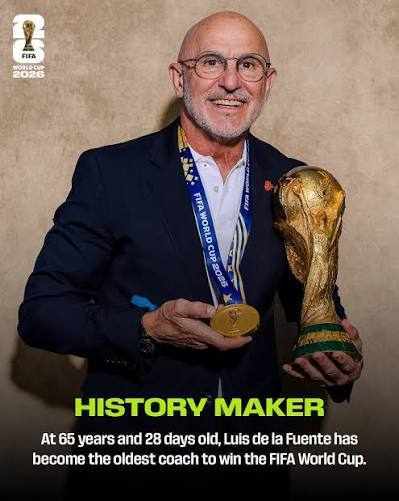
It took Spain 16 years to win another FIFA World Cup championship. Meet the “Marvel” who guided it to victory.
| From the desk of Miles Everson: Hi! I hope your week is off to a great start! Let’s begin this week by talking about a “Marketing Marvel.” Today, I’ll talk about the coach and manager of Spain’s national football team. Excited to know more? Continue reading below! |
For over a decade and a half, Spain's 2010 FIFA World Cup slowly faded into obscurity with every tournament. Then, in the summer of 2026, everything changed for Spain’s national football team. After 16 years, it was on the cusp of winning another FIFA World Cup… and this time, it was up against Argentina, the defending champion led by Lionel Messi, one of football’s most influential stars.
Photo from Unsplash While the odds looked insurmountable, Spain didn’t reach the FIFA World Cup final as an underdog whose back was up against the wall. You see, prior to the finals match, the team was in the midst of a 37-match unbeaten run, a record held since March 2024. By the time the final whistle blew, Spain extended its unbeaten record to 38 matches, and more importantly, it was world champion yet again. While this couldn’t have happened without Spain’s star players, behind every successful team is a coach setting them up for success. In this case, the “Marvel” behind its dominant run is none other than… Luis de la Fuente Castillo!
Image from FIFA de la Fuente Castillo (or de la Fuente, as he’s often referred to) serves concurrently as both coach and manager of Spain’s national football team. He has always been deeply connected to football, as he began his love affair with the sport during his younger years. This eventually led him to participate in Spain’s youth football system. The first team he played for professionally was Spanish-based team Athletic Bilbao , an organization where he spent his youth system years with. He eventually worked his way to the team’s senior team. de la Fuente’s tenure with Athletic Bilbao lasted from 1978 to 1987. He then returned to the team in 1991, playing for it until 1993. The other teams he played for were Sevilla and Alaves , football organizations that were also based in Spain. Aside from playing for football clubs, de la Fuente spent his career playing for Spain’s under-18, under-21, and Olympic football teams throughout his playing career. Coaching and Managerial Career de la Fuente retired as a football player in 1994. In 2000, he made his managerial debut with Club Portugalete , a regional football club. He then spent the next several years managing different teams. In 2013, he was appointed to lead Spain’s under-19 team, a post he held until 2018. From 2018 to 2022, he was tapped to lead the under-21 team. He was put in charge of Spain’s Olympic team for the 2020 Olympic Games held in 2021. Even though Spain’s Olympic team didn’t win gold, it managed to bring home a silver medal after losing to powerhouse Brazil. In 2022, de la Fuente was promoted to coach Spain’s national football team. With him at helm, he began to build the foundation for Spain’s 2026 FIFA World Cup win. Under his guidance, Spain put together a string of wins in major football competitions like the 2024 UEFA European Championship . As mentioned above, March 2024 marked the beginning of Spain’s unbeaten run of 38 straight games, with the latest of those wins stemming from the team’s 2026 FIFA World Cup campaign. There’s no doubt about de la Fuente’s status as one of football’s most elite coaches. That said, what enabled his rise to the top? de la Fuente's rise to the top didn't happen overnight. Becoming a championship-caliber coach required years of working his way up the ladder, a climb that demanded patience and perseverance. Prior to becoming Spain’s coach in 2022, he largely flew under the radar, spending his coaching career guiding multiple teams and youth squads. His long tenure within the Spanish national football ecosystem dates back to 2013. This meant that by the time he took the top job in 2022, he had already built the relationships, institutional knowledge, and coaching chops needed to assemble a winning team. Even so, he had only four years to construct a competitive roster for the 2026 FIFA World Cup. Pulling this off seemed daunting back then, but looking back, he managed to succeed because most of the players he called up were already products of the youth system, many of whom had represented Spain across various international tournaments. In most cases, these were the very same players he had scouted, recruited, and nurtured. That’s why Spain’s FIFA World Cup team—which had an average age of roughly 26 years old—possessed a level of cohesion that belied its average age. In other words, what looked at first glance like a young, unproven squad was, in fact, a group that had already grown accustomed to competing together on the international stage, laying the foundation for a championship-winning team. It also helped that these players were eager to prove themselves on the international stage, a hunger that de la Fuente recognized and nurtured on the way to an unbeaten run and most importantly, a championship win. — Clearly, de la Fuente's story is proof that great builders share these common traits: An eye for talent and the patience to let it grow . These qualities may seem like the hallmarks of a coach, but they're just as vital for any leader in any field. So, whether you're building a championship team, a career, or a company, the principle is the same. You need to have the patience to work towards your goals, and you also have to understand that you’ll need the help of other talented individuals to achieve them. Hope you’ve found this week’s topic interesting and helpful. Stay tuned for next Monday’s Marketing Marvels! Born in Stone Mountain, Georgia, Donald Glover grew up in a household that valued creativity, faith, and curiosity. Learn more about Childish Gambino in next week’s article! |



Miles Everson
CEO of MBO Partners and former Global Advisory and Consulting CEO at PwC, Everson has worked with many of the world's largest and most prominent organizations, specializing in executive management. He helps companies balance growth, reduce risk, maximize return, and excel in strategic business priorities.
He is a sought-after public speaker and contributor and has been a case study for success from Harvard Business School.
Everson is a Certified Public Accountant, a member of the American Institute of Certified Public Accountants and Minnesota Society of Certified Public Accountants. He graduated from St. Cloud State University with a B.S. in Accounting.