How did this cultural object in Thai temples & shrines spark a zero-pollution movement?
| From the desk of Miles Everson: Hello! Welcome to today’s edition of “Gorillas of Guerrilla Marketing.” For those of you who are new to this term, guerrilla marketing is a type of marketing with a goal to engage a brand’s target market in the most interactive, fun, and memorable way possible. In this article, let’s highlight a creative, sustainable, and revolutionary guerrilla marketing campaign. Curious? Continue reading below to know more! |
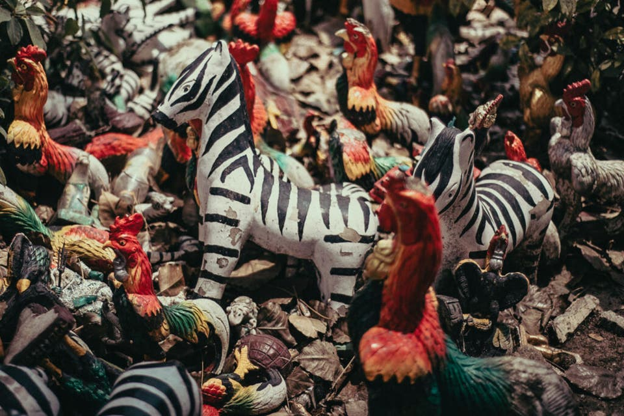
Across cultures, people perform symbolic acts to ask for protection, luck, or healing—rarely stopping to think about what happens after the prayer, wish, or request is answered. However, when millions of these rituals add up, even the most sacred traditions can leave behind an unintended environmental footprint. … and so today, we’ll learn about the story of how one deeply rooted cultural practice became the unlikely starting point for a guerrilla marketing campaign that didn’t disrupt tradition but simply evolved it. The Cultural Insight at the Heart of the Campaign In Thailand, spirit houses and shrines are more than spiritual landmarks; they are woven into everyday life. Locals and visitors alike come to make wishes, offer prayers, and, when those are fulfilled, return with votive offerings as a sign of gratitude. Among the most popular offerings are animal figurines—particularly zebras. Over time, this practice has scaled dramatically. More than 100,000 zebra figurines are produced each year to meet such a demand. Traditionally made from plaster, these figures eventually become waste… and because plaster is difficult to dispose of safely, the most common solution is incineration. That’s where the problem begins. In fact, Thailand already faces a serious PM2.5 air pollution crisis, and the burning of plaster figurines quietly contributes to the toxic haze. Sadly, what began as an act of gratitude ended up worsening the very environment people depend on. Based on these details, Dentsu Creative Thailand saw something most campaigns miss: A cultural behavior that could change , without erasing its meaning . Instead of calling for bans, guilt, or behavior-shaming, the campaign took a far more nuanced—and powerful—approach. Enter the “Zero Pollution Zebra” …
This wasn’t a billboard, a viral stunt, or even advertising in the traditional sense; it was a product intervention placed directly at the moment of ritual. By redesigning the votive offering itself, Dentsu Creative Thailand transformed a cultural habit into a living example of sustainable innovation, quietly embedded where it mattered most: temples and shrines. That’s guerrilla marketing at its finest—no interruption, no spectacle, just relevance! The “Zero Pollution Zebra” was designed to look familiar but behave very differently. Instead of plaster, the figurines were crafted from agricultural waste, bound together using fungi as a natural adhesive.
The production process involved drying and forming the zebras, then painting them with eco-friendly paints to maintain their visual and cultural integrity. What’s more? Unlike traditional figures that required incineration, the “Zero Pollution Zebra” was fully biodegradable ! Over time, it naturally decomposes and returns to the earth, transforming into soil and acting as a natural fertilizer. No smoke. No toxins. Zero pollution. … but wait, here’s the catch! Pulling this off required more than a clever idea. The campaign involved extensive research into sustainable materials, collaboration with agricultural producers, and careful testing to ensure the zebras were durable enough for use yet still capable of breaking down naturally. The most critical element was trust . Dentsu Creative Thailand partnered with temples, shrines, and environmental organizations to introduce the “Zero Pollution Zebra” as an alternative, NOT a replacement forced upon worshippers. By respecting spiritual traditions and working within existing belief systems, the campaign avoided resistance and invited participation. The results? The “Zero Pollution Zebra” campaign went far beyond awareness metrics!
Congratulations, Dentsu Creative Thailand for pulling this off creatively! *Applause* Clearly, the brilliance of the “Zero Pollution Zebra” lies in what it didn’t do. It didn’t shout… It didn’t disrupt… It didn’t demand behavior change through fear or pressure… Instead, it redesigned a familiar object at the exact point where belief, habit, and meaning already existed. The campaign lived inside culture, not on top of it. This is guerrilla marketing that understands a crucial truth: The most powerful interventions don’t ask people to abandon tradition; they help tradition adapt . Besides, the “Zero Pollution Zebra” proves sustainability doesn’t have to feel like sacrifice. When done thoughtfully, it can feel like continuity—an evolution that honors the past while protecting the future. … and sometimes, the boldest marketing move isn’t making noise—it’s making something better .Hope you’ve found this week’s guerrilla marketing insight interesting and helpful. Stay tuned for next Thursday’s Gorillas of Guerrilla Marketing! Do you want to know how one retail giant helped encourage healthier eating by designing a special plate? See it in next week’s article! |

Miles Everson
CEO of MBO Partners and former Global Advisory and Consulting CEO at PwC, Everson has worked with many of the world's largest and most prominent organizations, specializing in executive management. He helps companies balance growth, reduce risk, maximize return, and excel in strategic business priorities.
He is a sought-after public speaker and contributor and has been a case study for success from Harvard Business School.
Everson is a Certified Public Accountant, a member of the American Institute of Certified Public Accountants and Minnesota Society of Certified Public Accountants. He graduated from St. Cloud State University with a B.S. in Accounting.