AI can now write software solutions. Does that mean you should avoid (or dump) SaaS stocks?
| From the desk of Miles Everson: Investing has enabled many individuals to attain financial security and independence for decades. That’s why every Wednesday, I talk about investing to help and inspire readers to build their wealth through this activity. In today’s “The Independent Investor,” we’ll take a closer look at the wave of selloffs that have been hitting software stocks over the past few months. Curious? Keep reading below! |
A software update shouldn't be enough to spook the whole market. Unfortunately, investors don't seem to have gotten the message. In the middle of January 2026, artificial intelligence (AI) startup Anthropic released a new version of its flagship AI model, Claude. Anthropic's update included specific tools built for programmers. Claude doesn't just help write a single line of code anymore. With the update, it can take a prompt, write a full program, and launch it within hours. The market didn't like that piece of news one bit. For years, investors assumed AI would help software companies by boosting developer productivity and lowering costs. They weren't wrong. However, as Professor Joel Litman, Chairman and CEO of Valens Research and Chief Investment Officer of Altimetry Financial Research , pointed out, there has always been a second side to that story.
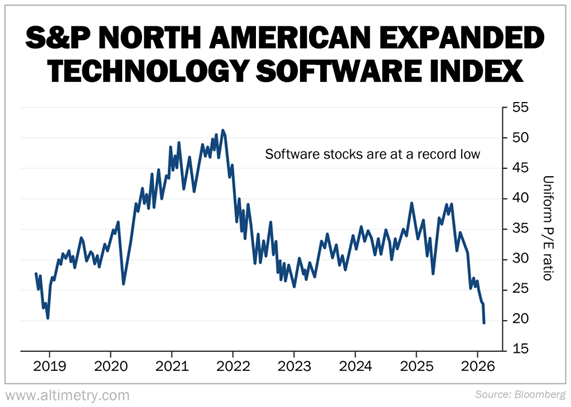
Professor Litman said if AI can develop software quickly, it can also lower the value of existing software by introducing new competition. When investors saw this in action, they panicked, and they haven't calmed down yet. The S&P North American Expanded Technology Software Index is down roughly 17% year-to-date. Companies in niche markets were hit the hardest. Take LegalZoom as an example, a firm that sells legal software. Anthropic's latest Claude release can quickly handle legal tasks like document review. LegalZoom's stock plunged on the news and hasn't recovered. It's down by around 30% since the start of January 2026. The selling didn't stop there, though. It spread across the market—from niche software providers to industry giants. Customer-relationship management leader Salesforce is down 20% since the start of 2026. Most of these businesses sell recurring software subscriptions, a business model known as Software as a Service (“SaaS”). If AI can build in hours what once took engineers weeks to build, pricing power and customer retention could crumble. That's why this broad sell-off has been dubbed the “SaaSpocalypse.” We’re not saying investors we’re wrong to panic, but the reaction has been emotional, which isn’t a good approach. On an as-reported basis, the software index now trades around at a 20x price-to-earnings (P/E) ratio. Put simply, software stocks are the cheapest they've been since the index was created in 2018.
Uniform Accounting shows a similar story. Last year, software companies traded at a 24x Uniform P/E ratio, right around the market average. Now, these firms just trade at 18x. Not every software company will escape the AI revolution unscathed. New tech will disrupt certain niches. Some products will be replaced. Nonetheless, Professor Litman emphasizes the bullish case for AI investment hasn't changed. If anything, it's getting stronger. Hyperscalers are still spending at record levels. Memory chips are completely sold out for the year. That's not what you'd see from an industry worried about a short-term shakeout. This isn't new information. Private creditors have feared disruption in certain parts of the software sector for months. As early as the middle of 2025, some of them stopped lending to software companies. The public market is finally catching up. As usual, it's overreacting. Big, tech-driven bull markets are never a straight ride up. They tend to come with multiple double-digit pullbacks. Those pullbacks feel scary at the moment. However, as long as credit remains healthy, they tend to become buying opportunities. Professor Litman and his team don’t see credit stress today. Lending is steady. Earnings expectations remain firm. Valuations have fallen as fear has increased. That's the setup long-term investors should want. Hope you’ve found this week’s insights interesting and helpful. Stay tuned for next Wednesday’s The Independent Investor! Imagine a world where everything looks unstoppable… Learn more about why growth isn’t enough in the AI era in next week’s article! |

Miles Everson
CEO of MBO Partners and former Global Advisory and Consulting CEO at PwC, Everson has worked with many of the world's largest and most prominent organizations, specializing in executive management. He helps companies balance growth, reduce risk, maximize return, and excel in strategic business priorities.
He is a sought-after public speaker and contributor and has been a case study for success from Harvard Business School.
Everson is a Certified Public Accountant, a member of the American Institute of Certified Public Accountants and Minnesota Society of Certified Public Accountants. He graduated from St. Cloud State University with a B.S. in Accounting.